What Happened
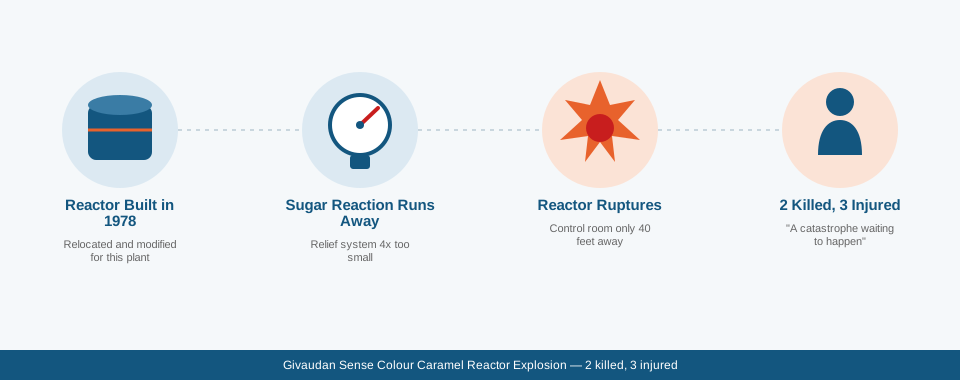
At 10:22 a.m. on November 12, 2024, operators at the Givaudan Sense Colour facility in Louisville, Kentucky, began a caramel coloring batch operation in a 2,500-gallon vessel known as Reactor 6, following the standard batch instruction for the process. Normal operating conditions were observed through the first several hours of the batch. At 2:17 p.m., as the batch instruction called for the next processing step, the sugar-based material inside the reactor underwent a runaway decomposition reaction. The reaction generated pressure far beyond what the vessel's emergency relief system could handle, and Reactor 6 ruptured violently. The blast wave struck a control room located only 40 feet from the reactor, a room that was not built to withstand an explosion; six employees were inside at the time. Two of them, Kevens Dawson and Austin Jaggers, were fatally injured when the room collapsed around them. Three other employees were seriously injured. Debris from the exploded vessel, including large pieces of the reactor itself, pipe fragments, instrumentation, and valves, was thrown outside the facility's fence line and into the surrounding Clifton neighborhood, with fragments found as far as 400 feet away. Local officials issued a shelter-in-place order for a one-mile radius around the plant. The explosion caused an estimated $30 million in damage to the facility and roughly $10 million in damage to the surrounding community. Givaudan permanently ceased operations at the site, which has since been demolished.
Root Causes
- Givaudan did not recognize the reactive hazard of the sugar ingredients: CSB's investigation found the company did not understand that the caramel coloring process involved sugar-based materials capable of undergoing a hazardous runaway decomposition reaction, even under conditions within the reactor's normal operating limits.
- The emergency pressure relief system was roughly four times too small: CSB determined the reactor's relief system would have needed to be approximately four times larger to safely vent the pressure generated by the runaway reaction that actually occurred.
- A decades-old reactor was relocated, modified, and returned to service without full reassessment: Reactor 6 was originally built in 1978 for a different facility that closed in 2008; it was placed in storage, then modified in 2021 to fit the Louisville facility's design and installed in the main manufacturing area.
- The control room sat too close to the reactor without blast protection: positioned only 40 feet from Reactor 6 and not constructed to withstand an explosion, the control room offered the six employees inside no meaningful protection once the vessel ruptured.
Lessons Learned
- Reactive hazard analysis needs to cover every material actually used in a process, including ones that might seem as routine as sugar-based caramel coloring ingredients. CSB's finding that this reaction could occur even within normal operating limits underscores that reactivity testing shouldn't be reserved only for materials that seem obviously hazardous.
- Emergency relief system sizing needs to be verified against the actual worst-case reaction the process could produce, not just routine operating conditions. A relief system four times too small provided the appearance of a safeguard without the actual capacity to function as one.
- Relocating and modifying older equipment for a new facility, as happened with this 1978 reactor, needs the same comprehensive hazard reassessment as installing entirely new equipment. Decades of prior service history at a different site doesn't establish that the equipment, or the process it's put into, is safe in its new context.
- Control rooms and other continuously occupied spaces near reactive process equipment need siting and construction that accounts for a realistic worst-case event. CSB's direct characterization of this incident as "a catastrophe waiting to happen" reflects how predictable the consequence was once the underlying hazard and relief system gaps existed together.