
What Happened
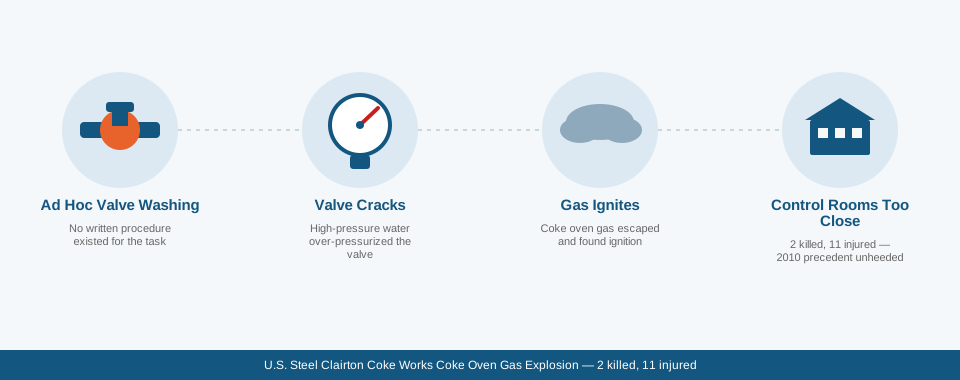
During a maintenance operation, U.S. Steel employees and a contractor from MPW Industrial Services were cleaning a large cast-iron valve in the coke oven gas system, part of the process that converts raw coal into coke for steel production. The workers were turning the valve back and forth to test whether it could fully close and found coke oven residue blocking its action. To clear the blockage, they pumped high-pressure water into the valve's seat to wash off the residue, but U.S. Steel had no written procedure specifying how this task should be safely performed. The over-pressurization from this improvised approach cracked the valve, releasing highly flammable, toxic coke oven gas into the air, where it ignited. The explosion killed two U.S. Steel employees, both working in separate control rooms at the time, and injured 11 others, including two of the seriously injured who were in a break room, and an air permit inspector who happened to be on top of a nearby coke battery. CSB found none of the buildings in the area, including the control rooms and break room, had been designed or constructed to withstand an explosion, despite roughly two dozen people regularly working in, below, and above that area. The facility, built in 1901, had experienced a broadly similar coke oven gas explosion in 2010 that CSB said should have prompted a serious review of how densely packed occupied buildings were positioned relative to hazardous process areas. That review never meaningfully happened before this second incident.
Root Causes
- No written procedure for a genuinely hazardous maintenance task: washing out a gas valve seat with high-pressure water was performed as an ad hoc, informal practice rather than following any documented, hazard-reviewed procedure, leaving the exact over-pressurization risk that occurred unaddressed by any formal safeguard.
- Poor facility siting relative to the hazard: control rooms and a break room, occupied spaces where people spend routine working hours, were positioned close enough to the process area that the explosion directly killed and injured people in supposedly "safe" indoor locations.
- Buildings not designed to withstand an explosion: none of the structures in the affected area had blast-resistant design, meaning ordinary building construction offered no protection once the gas cloud ignited.
- A prior, related incident's lesson wasn't acted on: U.S. Steel had experienced a 2010 explosion at the same type of facility that CSB said should have triggered a serious facility siting review, that review either didn't happen or didn't result in meaningful change before this second, still-more-severe event.
- An ineffective process safety management system overall: CSB's chairperson explicitly characterized the incident as resulting from the combination of an ad hoc procedure, poor siting, and a broader PSM system that wasn't effectively identifying or controlling these risks.
Lessons Learned
- Any maintenance task involving pressurized water, steam, or similar force applied to hazardous process equipment needs a written, hazard-reviewed procedure, "we've always cleared blockages this way" is not a substitute for formal hazard analysis, especially for equipment in flammable gas service.
- Facility siting review needs to explicitly evaluate occupied buildings, control rooms, break rooms, offices, against explosion and toxic release consequence distances, not just the process equipment itself; people spend the most concentrated time in exactly these "safe" indoor spaces.
- A prior incident at your own facility, or a similar facility type, is a direct call to action for siting and procedural review, this incident is a stark, recent example of a 2010 precedent not translating into the change that could have prevented a second, more severe event 15 years later.
- Buildings occupied by workers near hazardous process areas should be evaluated for blast-resistant construction where risk assessment indicates a credible explosion hazard, ordinary construction provides essentially no protection once ignition occurs.